



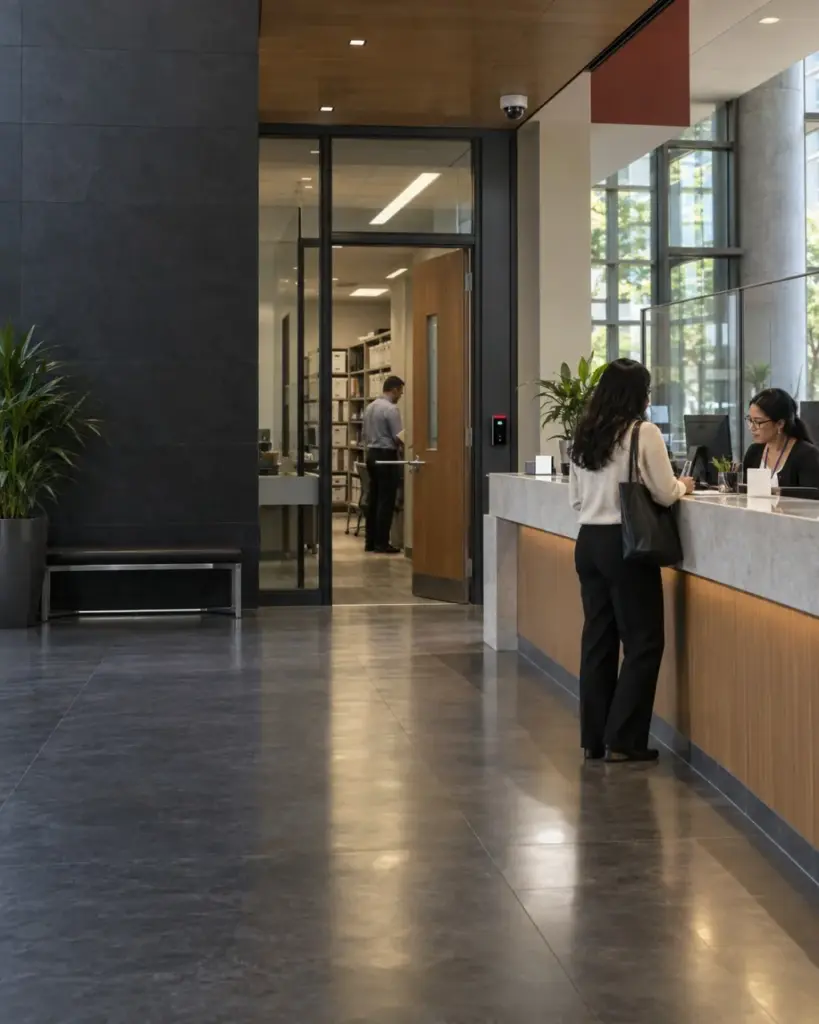




Owning a security system and actually running one are two different full-time jobs.
Managed Security Services
Firmware, user changes, and 2 a.m. alerts pile up on facility teams until the system is neglected. JMG SECURITY SYSTEMS takes over the day-to-day operation, so your security stays managed, monitored, and current.
✓
Not sure who's actually watching your alerts after hours? We'll show you what's currently falling through the cracks.
Local experience
Managing SoCal security operations since 1987
System approach
24/7 Live Monitoring
Infrastructure
Proactive System Maintenance
System fit
Dedicated Account Oversight
01 · Why owning a system isn't the same as running one
A System Can Degrade Without Active Management
Security infrastructure doesn't stay current on its own, user lists go stale, firmware falls behind, and alerts pile up unanswered the moment day-to-day ownership isn't clearly assigned to anyone.
01
Alerts get generated but nobody's watching in real time
An alarm that fires at midnight is only useful if someone's actually positioned to respond to it immediately.
JMG
JMG SECURITY SYSTEMS's live monitoring team watches, verifies, and responds around the clock.
02
User access lists quietly go out of date
Former employees, expired vendor credentials, and outdated permission levels accumulate when nobody owns the cleanup.
JMG
Ongoing user administration keeps access lists accurate as your team actually changes.
03
Routine maintenance keeps getting deprioritized
Firmware updates and health checks are easy to push off, until a preventable failure makes the cost of skipping them obvious.
JMG
Scheduled proactive maintenance catches issues before they become outages.
04
There's no single point of accountability for the system
When system ownership is split across IT, facilities, and security, small issues fall into the gaps between departments.
JMG
A dedicated account manager owns the relationship and the results, end to end.
02 · What managed security services actually include
Security Is Ongoing, Not A One-Time Installation
Genuine managed services extend well past the day equipment goes live, it's the continuous work of watching, maintaining, updating, and administering the system for as long as you rely on it.
01
24/7 live monitoring & alarm response
Trained operators watching, verifying, and escalating alerts in real time.
02
Proactive system health checks
Scheduled diagnostics that catch degrading hardware before it fails outright.
03
Ongoing firmware & software updates
Systems kept current without you having to track release schedules yourself.
04
User & credential administration
Access lists maintained accurately as employees, vendors, and roles change.
05
Dedicated account management
A single point of contact who owns your account's performance, not a rotating help desk.
06
Regular performance & activity reporting
Clear visibility into system health, incidents, and response times over time.
03 · How ongoing management actually works day to day
What Happens After Your Security System Goes Live?
Managed services isn't a single event, it's a repeating operational rhythm that keeps the system performing the same on day 500 as it did on day one.
Onboarding
System Is Onboarded Into Ongoing Management
Baseline health, users, and configuration documented at handoff.
Monitoring
Monitoring Team Begins Live Alert Coverage
Alarms and events routed to trained operators around the clock.
Maintenance
Scheduled Maintenance Keeps Performance Steady
Firmware, health checks, and updates run on a fixed cadence.
Administration
User And Access Changes Are Processed As They Happen
Additions, removals, and permission changes handled promptly.
Reporting
Performance Is Reported And Reviewed Regularly
Account activity summarized so you always know where things stand.
04 · What a JMG SECURITY SYSTEMS Project Can Include
What Can Managed Security Services Include?
The exact scope depends on the facility, the systems involved and the decision the organization needs to make. A JMG SECURITY SYSTEMS engagement can connect assessment and design with the work required to implement and support the resulting plan.
1. Monitoring coordination
Coordinate defined alarm communication, contact lists, instructions and event handoffs with JMG SECURITY SYSTEMS’s 24-Hour Monitoring service where contracted. Monitoring scope and third-party response are governed by the selected service and customer instructions.
2. System service and issue management
Receive and track covered service requests, coordinate troubleshooting and document open issues for the systems, locations and service windows included in the agreement.
3. Administration support
Where products, permissions and scope allow, support defined changes to users, credentials, schedules, roles or system settings through an approved request and authorization process.
4. System health and lifecycle visibility
Review available system information, recurring issues, software or license considerations and aging components to support maintenance and upgrade planning. Continuous health monitoring is included only where specifically supported and contracted.
5. Reporting and multi-site coordination
Provide agreed service, incident, inventory or activity summaries and coordinate common standards across locations while documenting site-specific exceptions.
6. Training, upgrades and ongoing planning
Support authorized users, refresh training where scoped, identify modernization needs and connect recurring service findings to future assessment, design and upgrade decisions.
How Do Standalone And Integrated Systems Management Differ?
A standalone system performs a defined function in its own application. An integrated system connects supported functions so operators can manage related events or data in a more coordinated workflow. Integration is not automatically the right answer for every site. JMG SECURITY SYSTEMS evaluates the operational benefit, compatibility, licensing, network, maintenance and change-management requirements before recommending an architecture.
How Are Cloud, On-Premise And Hybrid Options Evaluated?
The decision depends on operational control, IT policies, connectivity, cybersecurity responsibilities, update practices, storage or retention needs, user administration, integrations, capital and operating preferences, and product availability. A hybrid model may keep some functions or data on site while using cloud services for selected management or remote-access capabilities. JMG SECURITY SYSTEMS should document assumptions with the customer’s IT and security teams.
How does managed service support remote and multi-site management?
Managed service planning can define which roles need visibility, what each role may control, how credentials and alerts should be managed, and which information must remain local. Where selected products and licenses support it, centralized dashboards or mobile tools can help authorized teams manage multiple locations. Remote access must follow the customer’s network, identity, privacy and change-control requirements.
What is outside the standard managements service scope?
Unless a written scope states otherwise, this page does not describe cybersecurity testing, guard-force staffing, legal advice, emergency-response guarantees, a compliance certification or a promise that every vulnerability, blind spot, false alarm or incident will be eliminated. Fire-alarm design, permitting, inspections and monitoring must follow the applicable project scope and jurisdictional requirements. JMG should identify when a specialist or authority having jurisdiction is required.
Managed So Your Team's Time Goes Back To Actually Running The Business.
JMG SECURITY SYSTEMS absorbs the daily operational load of security management, so your internal staff isn't the one chasing alerts, updates, and access requests between everything else on their plate.
05 · Self-managed vs. professionally managed
Owning The Hardware Is Easy. Keeping It Running Isn’t.
The gap between a self-managed system and a professionally managed one rarely shows up on a quiet week. It shows up in the alert nobody caught, the ex-employee badge nobody deactivated, and the update nobody had time to install. A system that's technically installed correctly can still fail its purpose if nobody's actively operating it. Professional management is what keeps day one performance from quietly eroding into day five hundred neglect.
Self-managed system
Alarm response
Whoever happens to notice, whenever
Firmware & updates
Applied when someone remembers to
User access accuracy
Drifts out of date over time
Accountability
Split across departments informally
Visibility into performance
Rarely reviewed or reported
Staff time required
Ongoing internal burden
JMG SECURITY SYSTEMS-managed system
Alarm response
Trained operators monitoring 24/7
Firmware & updates
Scheduled and applied proactively
User access accuracy
Actively maintained as staff changes
Accountability
One dedicated account manager
Visibility into performance
Regular reporting on health and activity
Staff time required
Handled entirely by JMG SECURITY SYSTEMS's team
06 · Live-verified alarm response
Trained Operators Respond Before The Alert Reaches You
Every alarm is verified by a trained monitoring operator and escalated according to your response protocol, so most incidents are already being handled before the situation reaches your desk.
Dedicated account oversight
A Single Relationship That Owns The Outcome
Instead of routing issues through a general support queue, your account is overseen by a dedicated manager who understands your facility, your history, and your priorities.
Timeline
Enterprise Monitoring
Managed Services Activity Dashboard
Management priorities depend on how you operate
Every Operation Requires A Different Security Approach
The right managed services mix depends heavily on facility hours, staffing levels, turnover rate, and how many locations need consistent oversight at once.
High employee turnover environments
Ongoing credential administration that keeps access lists accurate as staff changes constantly.
After-hours or unstaffed facilities
Live monitoring that fills the coverage gap when no one's physically on-site.
Multi-location operators
Standardized management applied consistently across every facility in the portfolio.
Lean internal IT or facilities teams
Full operational offload for teams without bandwidth to manage security in-house.
Systems with irregular maintenance history
Proactive scheduled upkeep replacing reactive, as-needed servicing.
Compliance-driven industries
Reporting and documentation structured to support audit and compliance needs.
A Security System Is Only As Effective As The Team Operating It
Find out what's genuinely being watched, maintained, and kept current in your system right now.