








Your alarm system is only as good as the path your signal takes to get out of the building.
JMGCONNEX Private Mesh Radio
A private, self-healing mesh radio network for intrusion and fire alarm transmission, engineered to reduce dependence on phone lines and public cellular carriers. JMGCONNEX gives eligible Southern California facilities a privately managed communication path for compatible fire and intrusion alarm signals, so the moment an event triggers, the message isn’t riding on infrastructure JMG SECURITY SYSTEMS doesn’t control.
Not sure whether your alarm signal depends on a single phone line or carrier account? We'll show you exactly what path it's taking right now.
WHY A SINGLE COMMUNICATION PATH IS A QUIET LIABILITY
An Alarm System Can Be Flawless And Still Fail At The One Job That Matters Most.
Detection means little if the signal describing it never leaves the building, and most facilities have never actually examined what a single phone line or carrier outage would do to that outgoing message.
WHAT JMGCONNEX ACTUALLY DELIVERS
A Managed Radio Path, Not Another Account Layered Onto Your Existing System.
JMGCONNEX is a purpose-built communication service for compatible fire and intrusion alarm signals, engineered, provisioned, and serviced by the same team responsible for the alarm system itself.
HOW A SIGNAL ACTUALLY REACHES MONITORING
What Happens Between The Moment An Alarm Triggers And The Moment Monitoring Responds?
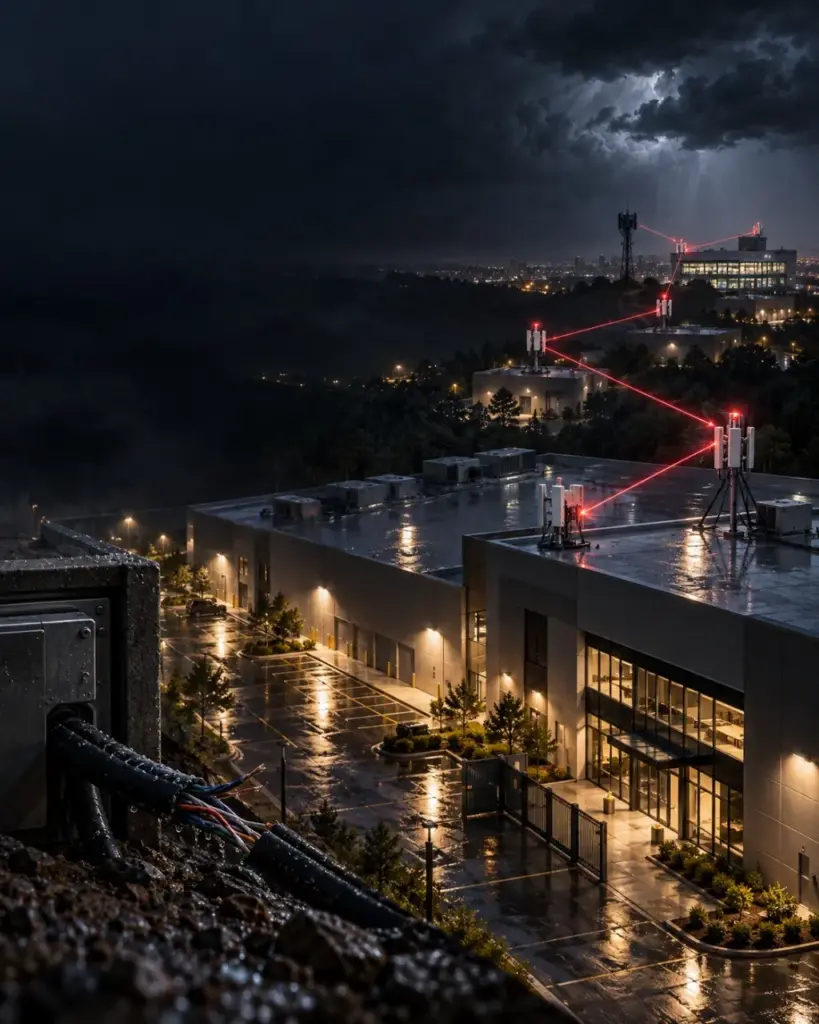
JMGCONNEX connects four distinct layers, the alarm panel, the premises radio, the private mesh network, and the monitoring environment, each engineered and tested as part of one coordinated communication chain.
No Phone Line. No Cellular Account at the Premises. Less Carrier Dependency.
What Happens To Your Alarm Signal When Everything Else Fails?
JMGCONNEX is designed to reduce dependence on public carrier infrastructure, but no responsible security provider should promise that every signal will get through under every imaginable condition. Successful alarm communication still depends on a functioning alarm panel, a powered and properly configured subscriber, viable radio routes, operational receiving infrastructure, correct account programming, and ongoing inspection and maintenance.
The real advantage is architectural: a mesh radio path does not rely on the same last-mile phone or public cellular connection that may be unavailable at the premises. If one mesh route cannot complete the transmission, the subscriber can use other viable routes in its routing table.
Built To Perform When Disaster Strikes
Southern California businesses plan for earthquakes, wildfires, flooding, severe storms, utility interruptions, and localized carrier outages. JMGCONNEX is designed to preserve an independent alarm communication option when public phone or cellular service at the premises is disrupted, but disaster resilience must be built across the full system – not claimed from the radio path alone.
JMG SECURITY SYSTEMS evaluates the communicator, panel, batteries, power supplies, antennas, receiving architecture, communication supervision, contact procedures, and service plan so the facility understands both the strength of the design and its remaining dependencies.

No Cellular Sunset Dependency For The Mesh Path
Public mobile carriers retire network generations as they reallocate spectrum and modernize service. The U.S. phaseout of major 3G networks required many alarm, elevator, medical-alert, vehicle, and industrial devices with 3G-only communicators to be replaced or upgraded. That history is the verified lesson; 4G has not been broadly retired across U.S. carrier networks as of this review.
JMGCONNEX avoids tying its RF mesh path to a public cellular generation. That means a carrier’s transition from one mobile technology to another does not, by itself, force replacement of the JMGCONNEX radio solely to preserve that mesh connection.
Why JMGCONNEX Is Different From Standard Carrier-Based Alarm Communication In SoCal?
Many alarm providers can install a cellular or IP communicator. JMGCONNEX gives JMG SECURITY SYSTEMS a different role: JMG SECURITY SYSTEMS manages the private mesh radio network used for the alarm path and connects it with system design, installation, monitoring, and service. That makes the network itself part of JMG’s operating capability, not simply a third-party account added to an alarm panel.
Is JMGCONNEX Reliable Enough For Fire Alarm Systems?
JMGCONNEX can be designed for qualifying commercial fire alarm communication using properly listed AES fire subscriber equipment and a configuration that meets applicable code and authority requirements. Reliability for a fire application is determined by the complete system – not by the word “mesh” alone.
JMG evaluates the alarm panel interface, subscriber listing, routing and supervision, receiver arrangement, primary and standby power, antenna installation, wiring, event transmission, monitoring station, inspection and test procedures, adopted NFPA 72 edition, local amendments, and authority approval before activation.
CARRIER-DEPENDENT VS. PRIVATELY MANAGED
A Working Alarm Signal Today Doesn't Guarantee A Working Alarm Signal During A Disruption.
The distinction between a single-path communicator and a mesh-routed one rarely surfaces on an ordinary day, it surfaces the moment the phone line, cell tower, or carrier network the signal depended on goes down.
A single communication path can perform reliably for years and still represent an unexamined point of failure. Mesh routing doesn’t eliminate that risk entirely, but it removes the shared last-mile dependency a public phone line or single carrier account creates.
ONE COMMUNICATION PARTNER
Availability Confirmed At The Property, Not Assumed From A Coverage Map.
JMG SECURITY SYSTEMS measures radio conditions at the exact address before recommending JMGCONNEX, so the decision is based on what the location can actually support rather than a general service-area claim.
A Self-Healing Network Can Select Another Route. It Still Needs A Route That Exists In The First Place.
Find out what communication paths are actually available at your exact address.
APPLICATION-SPECIFIC DESIGN
A Fire-Alarm Transmission Requirement Isn't The Same As A General Intrusion-Reporting One.
The right communication design depends heavily on whether the application is fire, intrusion, or both, and on the code, authority, and risk requirements attached to the specific facility.